Safety Essentials & Local Regulations

Make the Departure Checks

Clear safety habits—wearing flotation, clipping the kill-cord, checking official coastal forecasts, and knowing Norwegian marine rules—keep small-boat crews out of trouble when conditions shift.

Regulatory Disclaimer: Statutory rules summarized below reflect general Norwegian Maritime Authority (Sjøfartsdirektoratet) and municipal frameworks for recreational vessels. Always verify current statutory requirements and local municipal speed bylaws before operating a vessel.

1. Statutory Norwegian Boating Regulations

Both resident boat owners and visiting foreign skippers operating in Norwegian territorial waters must comply with core recreational boating regulations enforced by the police sea patrols and the Norwegian Coast Guard (Kystvakten):

  • Mandatory Lifejacket Wear (Påbud om bruk av flyteutstyr): Everyone onboard a recreational vessel with a hull length under 8 metres must wear a CE-marked personal flotation device whenever the vessel is underway outside in the open air. Even on vessels over 8 metres, approved flotation devices must be carried onboard for every person, and wearing them on deck is universal good seamanship.
  • Boating License (Båtførerbevis) & Age Limits: Any skipper born on or after 1 January 1980 must hold a Norwegian Båtførerbevis (or an accepted international equivalent such as the ICC) to operate a boat with an engine exceeding 25 HP (19 kW) or a hull length over 8 metres. Operators under 16 years of age may only helm boats up to 8 metres long with a maximum of 10 HP and a top speed not exceeding 10 knots. For vessels between 15 and 24 metres, a higher High-Speed or Deck Officer certificate (Fritidsskippersertifikat D5L) is required; moreover, from 2023 onward, a specific High-Speed Certificate (Høyhastighetsbevis) applies to vessels capable of 50 knots or more.
  • 0.02% Blood Alcohol Limit (Promillegrense): For recreational boats under 15 metres, the legal blood alcohol limit is 0.02% (0.2 promille)—identical to Norwegian road driving laws. For vessels of 15 metres or longer, a stricter 0.08% rule or commercial threshold applies.
  • Right of Way & Commercial Shipping (Nyttefartøy): Under Rule 9 and Rule 44 of the Norwegian Rules of the Road at Sea (Sjøveisreglene), recreational small boats must keep well clear of commercial ships, coastal express vessels (Hurtigruten / Havila), high-speed passenger catamarans, and car ferries operating in confined fairways. Never cross close ahead of a fast ferry; their stopping distance is long and they approach at 30+ knots with minimal engine noise.

Essential Onboard Safety Gear

Check that crew members know the exact location and operation of these three critical items before leaving the berth.

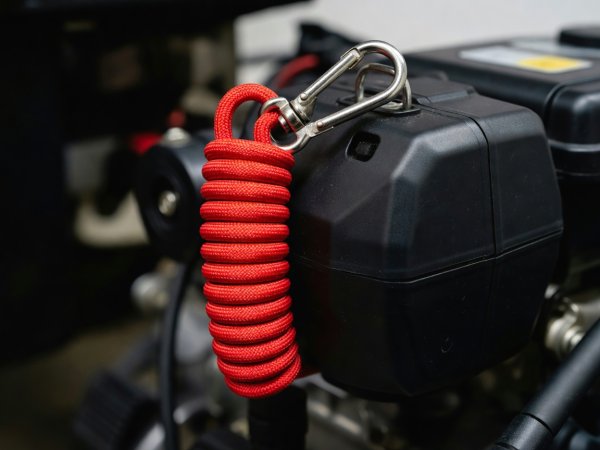
Close-up of a coiled red engine kill-cord lanyard clipped to a throttle control box Helm Control

Kill-Cord Lanyard (Dødmannsknapp)

Clip the red stop lanyard around the helmsman's thigh or lifejacket harness before shifting into gear, and keep a spare lanyard taped near the helm so another crew member can restart the engine if the skipper goes overboard.
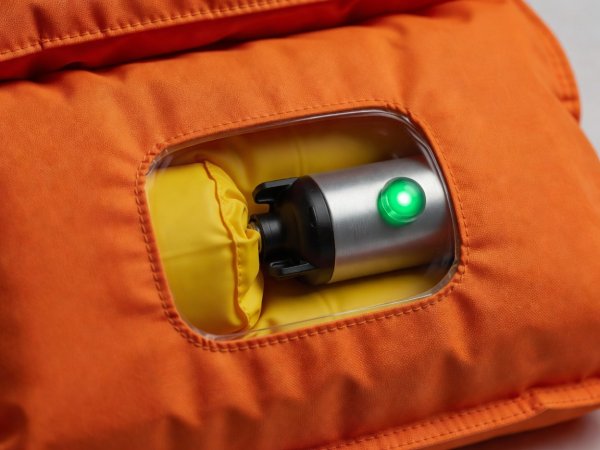
Close-up of an automatic inflatable lifejacket bladder window showing a green status indicator Flotation & Recovery

Lifejacket Cartridges & Swim Ladder

Unscrew and weigh the 33g CO2 cylinder on automatic vests each spring, check the hydrostatic bobbin expiry date, and ensure your stern boarding ladder can be pulled down into the water by a swimmer without assistance from deck.

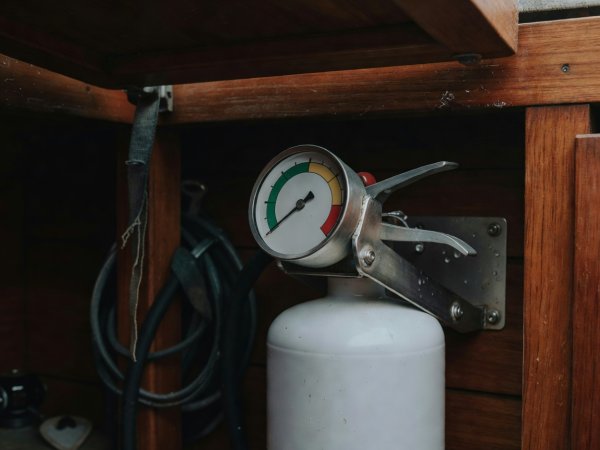
Close-up of a pressure gauge in the green zone on a marine fire extinguisher mounted in a cockpit locker Fire & Distress

Fire Port, Extinguishers & LED Flares

Invert dry-powder extinguishers periodically so the powder does not cake from hull vibration, verify your engine box fire port allows discharging without lifting the hatch, and store distress signals in a grab bag.

2. Emergency Contacts and Communications

Even in the height of summer, Norwegian coastal water temperatures remain cold enough to induce cold-water shock and rapid loss of finger dexterity. Know how to summon assistance immediately:

  • Life-Threatening Emergency at Sea: Press the red DSC Distress button on your VHF radio for 5 seconds, call "MAYDAY" on VHF Channel 16, or dial 112 (Police / Joint Rescue Coordination Centre - Hovedredningssentralen) or 120 (Kystradioen direct emergency line) by phone.
  • Non-Urgent Tow & Mechanical Assistance: Contact the Norwegian Society for Sea Rescue (Redningsselskapet - RS) on their non-emergency service phone (+47) 02016 or via your local Kystradio working channel.

3. Reading Coastal Weather and Wave Models

Mountain topography along the Norwegian coast bends wind direction and accelerates air through narrow fjords (funneling and katabatic fall-winds). Before departing any harbour, cross-check two official sources:

  1. Yr.no Coastal Forecast (Kystvarsel): Maintained by the Norwegian Meteorological Institute and NRK. Look specifically at the wind gust figure (written in parentheses next to sustained metres per second). A sustained breeze of 8 m/s with gusts of 15 m/s will create steep whitecaps in open sounds.
  2. BarentsWatch Wave Forecast (Bølgevarsel): Models real-time and forecasted significant wave height, maximum wave height, and wave period along 55 exposed coastal passages. Pay close attention when short wave periods coincide with opposing coastal currents (such as the North-going Norwegian Coastal Current meeting a northerly wind).

4. Responsible Marine Tourism & Coastal Etiquette

Norway's coastline supports commercial fisheries, aquaculture, seabird colonies, and tranquil island communities. Keep the coast welcoming by observing these practices:

  • 20-Metre & 100-Metre Aquaculture Buffers: It is strictly illegal to fish within 100 metres or transit closer than 20 metres to salmon aquaculture cages (oppdrettsanlegg). Watch for heavy black mooring hawsers extending far out from the corner buoys of fish farms.
  • 300-Metre Septic Discharge Rule: Discharging untreated sewage from boat holding tanks is prohibited within 300 metres of the mainland and islands in most coastal municipalities—and across the entire inner Oslofjord and southern archipelago, strict zero-discharge rules direct skippers to use municipal pump-out stations.
  • Shoreline Access & Private Piers: Under allemannsretten, you may moor temporarily in uncultivated nature (utmark) for up to 48 hours without landowner permission, provided you stay respectful distances away from inhabited houses and private cabins. Never moor to private boathouse piers or private buoys without explicit invitation, and never light open campfires on bare granite rocks (which crack irreversibly from heat) or anywhere during the statutory forest-fire ban from 15 April to 15 September.